
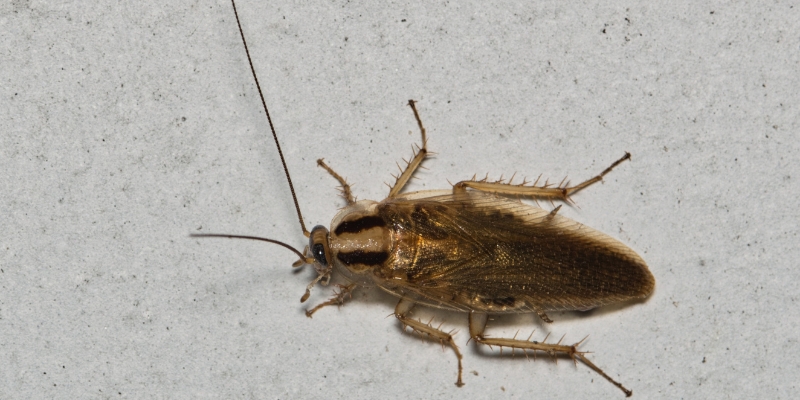
I got a call this week from a customer who was panicking. Understandably. She'd had a pest control company out to her ADU for German cockroaches, and she was still seeing them. Naturally, she assumed the bugs were winning.
They weren't. The company just never had a chance.
Here's what actually happened: in one week, they treated that unit four separate times. Some of that material had a six-month residual—meaning it's engineered to keep working for half a year—and they reapplied it twice in seven days.
That's not treating a roach problem. That's just throwing darts at a dartboard blindfolded and hoping one sticks.
Let's Talk Roach Math (Because It's Wild)
If you had one male and one female German cockroach, and every single one of their offspring survived and bred right on schedule, you could theoretically end up with over 30,000 cockroaches in a single year. From two bugs.
Now relax—that's not reality. Nature is cruel to cockroaches too, and most of them don't survive long enough to keep the family business going.
But this customer's tenant had reportedly been living with this problem for ten months. Ten months of two roaches theoretically becoming a small nation is exactly why "just spray it a few times and see what happens" doesn't work.
This isn't a garden weed. It's a math problem with legs.
Mistake #1: They Used a Repellent
The very first material this other company used was highly repellent. Great—except that's the opposite of what you want with German roaches. Instead of controlling the population where it lived (the kitchen), it scattered them throughout the entire structure.
Congratulations, you just gave a localized problem a passport.
German roach control lives and dies on containment. You want the population isolated, not evacuating to every room like it's a fire drill.
That's why we lean on baiting strategies instead of blasting sprays around—baits let roaches take the material back to where they're hiding, instead of chasing them into your walls, your neighbor's unit, and your nightmares.
Mistake #2: They Missed the Evidence
Here's a detail most people don't think about: German roaches aren't a "colony" like ants or bees, but they do hang out together. When they find a good hiding spot, they leave behind a pheromone that says, "great real estate, tell your friends." Other roaches follow that scent and congregate in the same cracks and crevices.
And when they gather like that, they leave droppings—little speckled marks, usually right at the mouth of the crack they're hiding in. It feels like sandpaper, and if it's been there a while, you're not wiping it off with a paper towel. Sometimes you're sanding it or painting over it.
When I inspected this unit, there wasn't any of that telltale fecal staining. Which tells me the population was still moving, still scattered, still confused—because it had never been given the chance to settle and be controlled properly in the first place.
So Whodunit? The Case of the Missing Evidence
Here's why all of this actually matters: figuring out where an infestation came from. Was it the previous tenant's mess following them in, or did the new tenant walk into a problem that was already brewing?
Based on what I found, I don't think this was ten months of unchecked buildup. If it had been, I'd expect a lot more fecal staining, and I'd expect more than two shed exoskeletons (that's the cast-off "shell" a roach leaves behind when it molts and grows into a bigger one).
Ten months of real activity should leave a paper trail. I found two data points after a thorough search. That's not a decade-long crime scene—that's a population that had already been knocked down.
The previous company also never put out glue boards. Which, respectfully, how are you supposed to know what's actually happening in a structure without them?
Glue boards are how we monitor activity over time. Cameras exist, sure, but a glance at a glue board tells you more about what's really going on than hours of footage ever will.
Once we got monitoring in place, the picture became clear: what the other company did was actually working. The customer just had no way of knowing that, because nobody ever explained the process to her.
Here's the Part That Actually Breaks My Heart
It's easy to be mad at the other company. I'm not, really. Because in most cases like this, it's not the technician's fault.
It's a training problem. Somewhere, an owner didn't make sure their team actually understood what these materials can and can't do—how residuals work, why repellents backfire, and why patience isn't optional with German roaches.
A tech who's never been taught that a six-month residual needs six months (not six days) is going to keep spraying out of panic, because that's the only tool they were handed.
That's on leadership, not the person holding the sprayer.
Why "Just Trust the Process" Actually Matters
This wasn't just a bug problem. It was an income problem. This customer rents out her ADU, and her tenant understandably didn't want to keep living somewhere they were still seeing cockroaches.
That's lost rent on a property she's still paying a mortgage on—real money, walking out the door because nobody took the time to explain what was actually happening.
Here's the kicker: if she'd understood the process from day one, I would have encouraged that tenant to stay put. German roaches are champion hitchhikers. Move out in a hurry, and there's a real chance you're taking a few stowaways with you—straight into your new place.
Sometimes the "fix" for the tenant is actually just relocating the problem.
The Bottom Line
German roaches are patient. Your pest control needs to be too. At The Pest Posse Too, our green protocols are built around containment, correct material selection, and giving properly placed baits the time they need to actually work—not blanket-spraying synthetics and hoping for the best.
It's not flashy. It's not four treatments in a week.
But just as important as the treatment itself is the conversation around it. A customer who knows what to expect—how long it takes, what the evidence means, and what "working" actually looks like along the way—is a customer who isn't panicking, isn't losing tenants, and isn't losing sleep.
That's the peace of mind the previous company couldn't give her. It's the one thing I'm always going to make sure we hand back to every customer, roaches or not.
Bringing you peace of mind, nature's way—and yes, occasionally saving you from becoming a roach math statistic.
Up next in this series: a full breakdown of our green German cockroach protocol—what we actually do, step by step, and why.
